Tuning the CGAN model from book GANs in Action
December 18, 2021
I’ve been reading the book GANs in Action recently and playing aroung the models in it. However, the CGAN model example in Chapter 8 doesn’t give satisfactory result in current version of tensorflow:
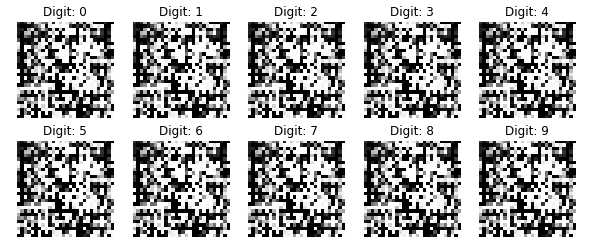
After some tuning I managed to get the final result:
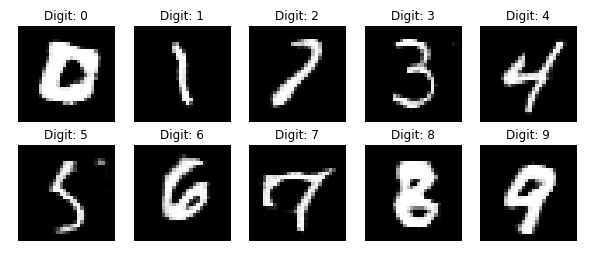
Here’s the modifications I made, hope it’s useful to someone also reading this book. In short:
- Remove the
BatchNormalizationlayers in discriminator - In
build_cgan_generator, instead ofMultiply,Concatenatethe random noise vector and label embedding - Set
trainable=TrueforEmbeddinglayers in generator and discriminator
BatchNormalization layer
The current discriminator implementation contains two layers of BatchNormalization:
def build_discriminator(img_shape):
    model = Sequential()
    ...
    # Batch normalization
    model.add(BatchNormalization())

    # Leaky ReLU activation
    model.add(LeakyReLU(alpha=0.01))
    ...
    # Batch normalization
    model.add(BatchNormalization())
    ...
    return model
I found I could improve result only if I remove those two layers. The reason might be the two
BatchNormalization layers make the discriminator too powerful for the generator, which makes
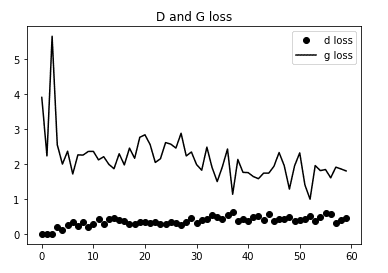
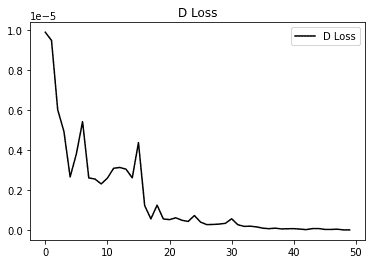
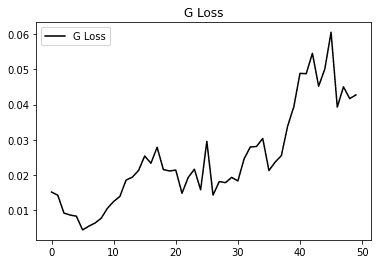
improvement of generator impossible. This can be proved by the following loss graphs.
This is the loss graph without the above BatchNormalization layers:
Loss graph with the above BatchNormalization layers:
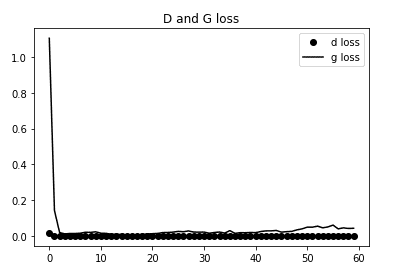
The initial loss values are too large, which causes the trend looks not clear in the above graph. After removing the big values in the front we can see the generator loss is increasing:
Concatenate noise and label
Another change I had to make is changing the way label embedding is combined with noise vector z from multipy:
def build_cgan_generator(z_dim):
    ...
    # Element-wise product of the vectors z and the label embeddings
    joined_representation = Multiply()([z, label_embedding])
    generator = build_generator(z_dim)
    ...
to Concatenation:
def build_cgan_generator(z_dim):
    ...
    joined_representation = Concatenate(axis=-1)([z, label_embedding])
    generator = build_generator(z_dim + z_dim)
    ...
Maybe it’s because the label embedding pattern is not ‘obvious’ after multiply with random noise vector.
Freeze Embedding layer
By default the Embedding layer has some parameters and is trainable. I found leaving it trainable
results in slightly blur result:
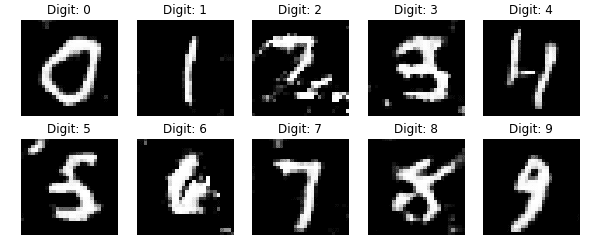
Setting trainalbe to False in Embedding layers improve the result, which I think makes sense — the label embedding is used as condition, and the condition should be fixed for a specific label.
One-hot encode the label
This is not nessecary change. It’s another way to to represent label and it’s used in the Keras CGAN example. I tried on hot encoding and find it has similar result with Embedding layer. The corresponding
change are as follows(Adapted from Keras example):
Generator:
def build_cgan_generator(z_dim):
    ...
    label_embedding = CategoryEncoding(num_tokens=num_classes, output_mode="one_hot")(label)
    joined_representation = Concatenate(axis=-1)([z, label_embedding])
    generator = build_generator(z_dim + 10)
    ...
Discriminator:
def build_cgan_generator(z_dim):
    ...
    label_embedding = CategoryEncoding(num_tokens=num_classes, output_mode="one_hot")(label)
    label_embedding = layers.Lambda(lambda x: tf.repeat(x, repeats=np.prod(img_shape)))(label_embedding)
    label_embedding = layers.Lambda(lambda x: tf.reshape(x, (-1, img_shape[0], img_shape[1], num_classes)))(label_embedding)
    ...
Written by Jesse W. Follow me on Twitter